Starting from a reflection on the fast pace of contemporary reality, the attention span deficit, the dwindling depth of communication, and the diminishment of attentive listening, the group exhibition The Sounds of Silence explores the power and multiple facets of silence through works by nineteen contemporary Greek artists, most of which have been created specifically for this exhibition. What is it that happens in silence, how do memory, imagination, and thought function? What do we see and feel, and what is the language of silence? In this silent, soundless exhibition, “sounds” are understood metaphorically as breaths, whispers, withheld stories, as traumas and losses, memories or dispositions, as the hidden but nevertheless existent “sounds-echoes” which showcase silence as a place of awareness, serenity, self-consciousness, of anticipation and desire, of transformation and connection with the inner gaze. The works activate the bodily perception of sound and image, expand the senses, and bring to the fore the latent memory or the echo of reality. Silence is presented as part of human existence, as a dialogue with oneself, but also with others, uniting reality and imagination. Just as a void is not the absence of space, or pause is never completely static, so silence too is not a void, but a state of contrasts, constant alternations, rhythms, and nuances. The aim here is not to “illustrate” silence, it is not only silence as a subject but also silence within the work of art, that is, the detection of silence through the language of art itself: such as the rendering of space, light, color, and the sense of time within the static image. Most of the works are abstract or tend towards abstraction, fragmentation, and the highlighting of the minimal. Silence is treated as an encounter between seemingly opposing forces.
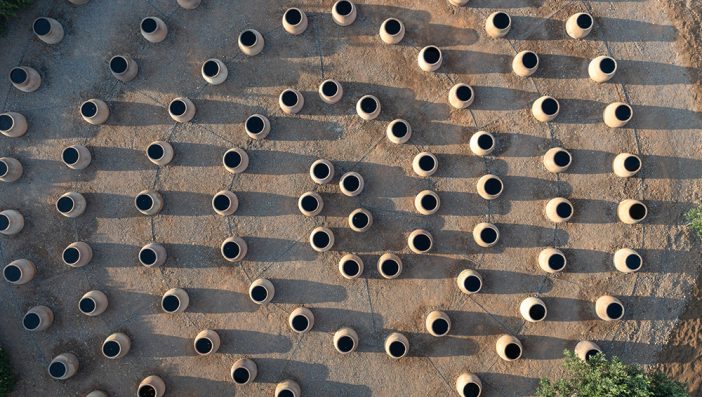
Following the site-responsive interactive installation, the artist creates in 2025 -based on aerial photography of the on-site installation- two new etchings that trace the paths of the flows, mentally transporting them from the farm of distant Australia to the gallery space. In Making the Invisible Visible – From Land to Paper, (etching-relief made with special analogue and digital techniques in three stages) the paths become intensely incised while in Water Traces – From Land to Paper (etching-oxygraphy, special analogue and digital techniques in three stages) they are imperceptibly incised. With the simplicity and purity characteristic of Danae Stratou’s entire work, she “transfers” the original work to the enclosed space of the gallery and transforms the manual labour of carving the earth that the land-art work required, as well as the manual labour of engraving, into images of an airy sensation that seem to have been made by a light touch.